Feel confident every day.

Testosterone Replacement Therapy (TRT)
Boost energy and vitality with testosterone therapy
Feel confident every day.

Testosterone Replacement Therapy (TRT)
Boost energy and vitality with testosterone therapy
We'll walk you through every option at your pace.

Dermal Fillers for Augmentation
Your privacy and discretion are fully protected with us
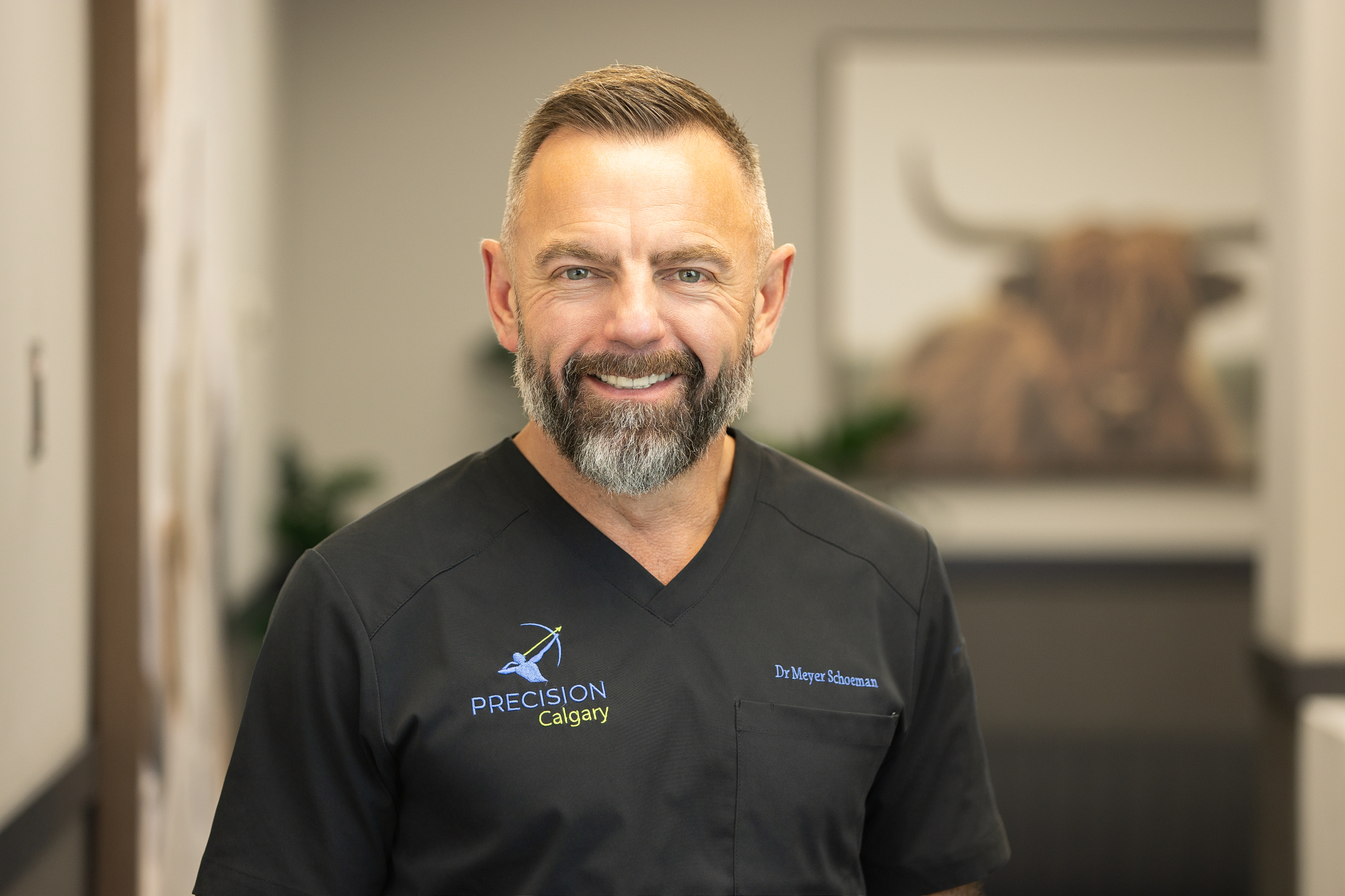
By Dr. Meyer Schoeman, MD — Precision Sexual Health Clinic, Calgary
One of the most clinically important and least-discussed aspects of Peyronie’s disease is that it is not a static condition. It evolves through distinct phases, and the appropriate treatment approach differs significantly depending on which phase the patient is in.
Men who come in having researched treatment options online often have a general sense of what is available, but not a clear understanding of when each option is appropriate. That distinction can make a meaningful difference to outcomes.
The active phase — also called the acute phase — is characterised by ongoing collagen deposition and plaque development in the tunica albuginea. Clinically, this presents as penile pain with erection, progressive change in curvature or deformity, and palpable plaque that may be changing in size. The active phase typically lasts six to eighteen months from symptom onset, though this varies considerably between individuals.
During the active phase, the fibrotic process is ongoing. This has two important implications for treatment. First, surgical correction is contraindicated, because operating on actively evolving scar tissue produces unpredictable results and risks worsening the deformity. Second, there is a rationale for interventions that may modulate the fibrotic process itself rather than simply addressing established deformity.
Anti-fibrotic oral agents, shockwave therapy to reduce plaque activity and pain, and mechanical traction devices are all more logically applied during this phase when the plaque is still responsive to modification.
Penile pain during erection typically improves or resolves as Peyronie’s disease transitions out of the active phase. In a study published by the Asian Journal of Urology, pain resolved within the first year in more than 90% of patients, even though the underlying curvature or deformity may persist. What has actually happened is that the inflammatory component has subsided while the fibrotic deformity remains.
The stable phase is reached when penile curvature and plaque characteristics have not changed over a period of at least three months, in the absence of ongoing pain. The fibrotic process has concluded. The tunica albuginea has a fixed deformity that is no longer evolving.
In the stable phase, surgical correction becomes a viable option for men who are significantly bothered by their curvature and who have adequate baseline erectile function. The available procedures — penile plication, plaque incision and grafting, or penile prosthesis in men with concurrent severe ED — carry more predictable outcomes when performed on established, stable disease.
Non-surgical restorative treatments such as shockwave therapy and PRP continue to have a role in the stable phase, particularly for improving associated erectile dysfunction and overall penile vascular health, though their impact on established curvature is more limited than on active-phase disease.
A significant proportion of men with Peyronie’s disease delay seeking evaluation for six months to two years after symptom onset. The reasons are predictable: embarrassment, the hope that it will resolve on its own, and a lack of awareness that treatment exists. The clinical cost of that delay is real. Men who present during the active phase have more treatment options, and interventions during this window have the potential to limit the ultimate degree of deformity.
The data on untreated Peyronie’s disease is sobering: the Canadian Urological Association guideline for Peyronie’s disease states that only 12% of men see spontaneous improvement in curvature without treatment, while 48% to 76% experience disease progression. Watchful waiting is not a neutral strategy.
If you have noticed penile pain with erection, a new or changing curvature, or a palpable lump or plaque in the penile shaft, seek evaluation promptly. The earlier in the disease course you are assessed, the more options are available and the better the likely outcome. The active phase is the window during which treatment has the greatest potential to modify disease trajectory.
Waiting to see if it resolves on its own is understandable. Based on the natural history data, it is also, for most men, the wrong decision.
Take the first step and book a consultation at Precision Clinic Calgary today.
Dr. Meyer Schoeman is the founder of Precision Sexual Health Clinic for Men in Calgary, offering comprehensive ED assessment and treatment for men of all ages. Book a consultation at precisioncliniccalgary.ca.