TRT and Fertility: What Nobody Tells You Before You Start

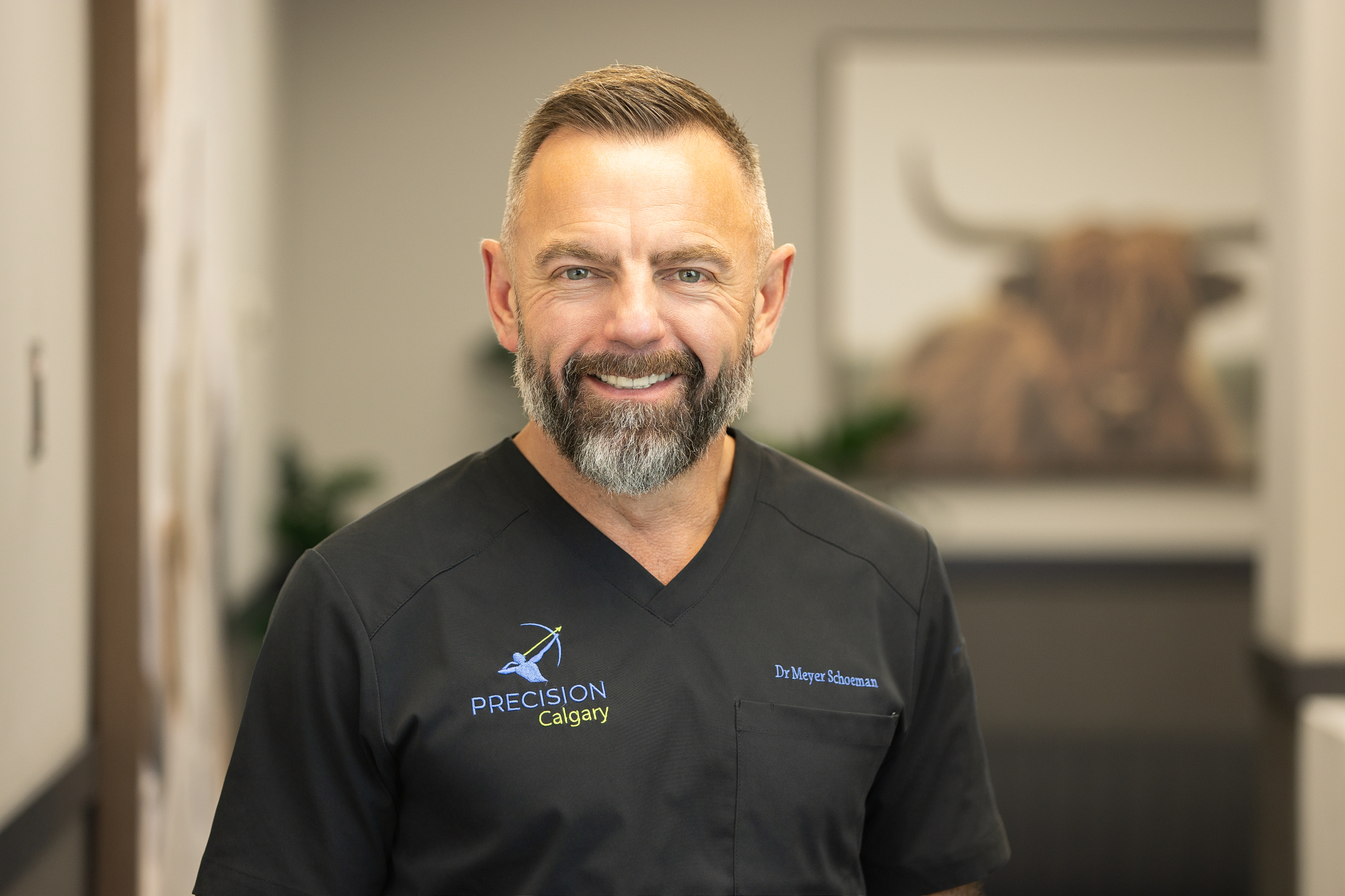
By Dr. Meyer Schoeman, MD — Precision Sexual Health Clinic, Calgary

Men who come in for a testosterone consultation are usually thinking about one thing: feeling better. More energy, better body composition, improved libido, sharper focus. What most of them aren’t thinking about — until I bring it up — is what TRT does to their ability to have children.

This conversation matters. And the fact that it often doesn’t happen before treatment starts is one of the biggest problems in how testosterone therapy is currently being delivered.

Exogenous Testosterone Suppresses Your Natural Production

When you introduce testosterone from an outside source, your hypothalamic-pituitary-gonadal (HPG) axis responds predictably: it downregulates. The hypothalamus detects adequate circulating androgen and reduces gonadotropin-releasing hormone (GnRH) pulse frequency. The pituitary follows by cutting back luteinizing hormone (LH) and follicle-stimulating hormone (FSH) secretion. Without LH signalling, the Leydig cells in your testes stop producing endogenous testosterone. Without FSH, spermatogenesis slows — and in some men, stops entirely.

The practical result: testicular atrophy and, in many cases, azoospermia or severe oligospermia. How quickly this happens and how pronounced it becomes varies between individuals, but suppression is the rule, not the exception. Published research on testosterone-induced infertility has consistently shown that exogenous testosterone can significantly suppress sperm production in reproductive-age men.

For a man in his 50s who is done having children, this may be an acceptable trade-off. For a man in his 30s who isn’t, it’s a significant problem — especially if nobody mentioned it before he started.

The Good News: There Are Options

This is where the conversation gets more interesting — and where clinic protocols really differ.

Human chorionic gonadotropin (HCG) is an LH analogue. When administered alongside testosterone, it maintains the LH signal to the Leydig cells, preserving intratesticular testosterone production and, with it, testicular volume and spermatogenic function. This is the most established approach for men on TRT who want to preserve fertility potential.

It’s also the only non-testosterone treatment for testosterone deficiency syndrome that is approved by Health Canada, and it’s included as a recognized option in the 2021 Canadian Urological Association guideline on testosterone deficiency syndrome. The guideline also emphasizes discussing fertility goals before initiating therapy in younger men considering TRT.

The alternative — particularly for men who want to raise their testosterone without suppressing the HPG axis at all — is a selective estrogen receptor modulator (SERM). Enclomiphene and clomiphene both work by blocking estradiol’s negative feedback at the hypothalamus and pituitary, which causes a rise in LH and FSH and therefore a rise in endogenous testosterone production. Spermatogenesis is maintained. In some men, fertility actually improves on this approach.

Neither of these options is appropriate for everyone. HCG is less effective as monotherapy for symptom relief than combined TRT, and SERMs don’t achieve the same testosterone levels as direct replacement in men with significant primary hypogonadism. But for the right patient, they’re not compromises — they’re the correct treatment.

What Happens If You’ve Already Been on TRT for a While?

Suppression is generally reversible, but recovery is not guaranteed and it’s not always quick. Most men regain spermatogenic function within three to eighteen months of stopping testosterone, but the range is wide and some men recover poorly — particularly those who were on high-dose depot injections for years without any HPG axis support.

If you’re currently on testosterone and now thinking about fertility, the protocol shifts to stopping exogenous testosterone and initiating HCG, clomiphene, or both to stimulate HPG axis recovery. It’s manageable in most cases, but it’s a more complicated situation than simply never having suppressed the axis in the first place.

The Questions to Ask Before You Start Testosterone Therapy

If you’re considering TRT and have any possibility — even remote — of wanting children in the next several years, these are the questions that need answers before you start:

  • Is HCG co-administration part of the protocol?
  • If the answer is no and there’s no discussion of why, that’s a gap.
  • Is a SERM-based approach appropriate for my situation?
  • Has my baseline semen analysis been discussed?

If fertility is genuinely important to you, a baseline semen analysis before initiating any therapy gives you a reference point and sometimes reveals pre-existing issues that change the treatment decision entirely.

TRT can be the right decision for a man who wants children someday. But it needs to be the right version of TRT — one that takes that goal seriously from the start.

Precision Clinic in Calgary offers HCG co-administration protocols, SERM-based testosterone optimization, and fertility-preserving approaches to testosterone deficiency. Book a consultation at Precision Clinic Calgary.